
Search for a memory test and you will find free quizzes, clinic screens, brain training games and full neuropsychological assessment, all described in roughly the same language. They are not the same thing and they do not answer the same question.
Here is what each is actually for.
Free online quizzes
Usually a handful of multiple-choice questions, or a game that measures reaction time. They are free, immediate, and entertaining.
The limitation is structural rather than a matter of quality. Recognising the right answer from a list is a much easier task than recalling something unprompted, and the easier task is the one that stays intact longest as memory changes. A test built on recognition will tend to look reassuring for longer than it should.
They also compare you to nobody in particular. A score without normative data cannot tell you whether your result is expected for a person of your age and education, which is the only comparison that means anything.
Clinic screening tests
The MMSE, the MoCA and the SAGE are short screens designed to be administered by a clinician in a consulting room. They are well studied and widely used, and if your doctor gives you one, that is a good thing.
Their constraints are practical. They require an appointment. They are usually given once, at the point when somebody is already worried, which means there is rarely a baseline to compare against. And because they are brief and widely circulated, repeat exposure to the same items can flatter a second attempt.
Full neuropsychological assessment
Several hours with a clinical neuropsychologist, covering memory, language, attention, executive function and mood, interpreted alongside your history and often your imaging.
This is the most informative option by a wide margin, and it is the right answer when there is a real diagnostic question. It is also expensive, often has a long waiting list, and is not a reasonable way to check on a vague worry.
Where the Memory Exam sits
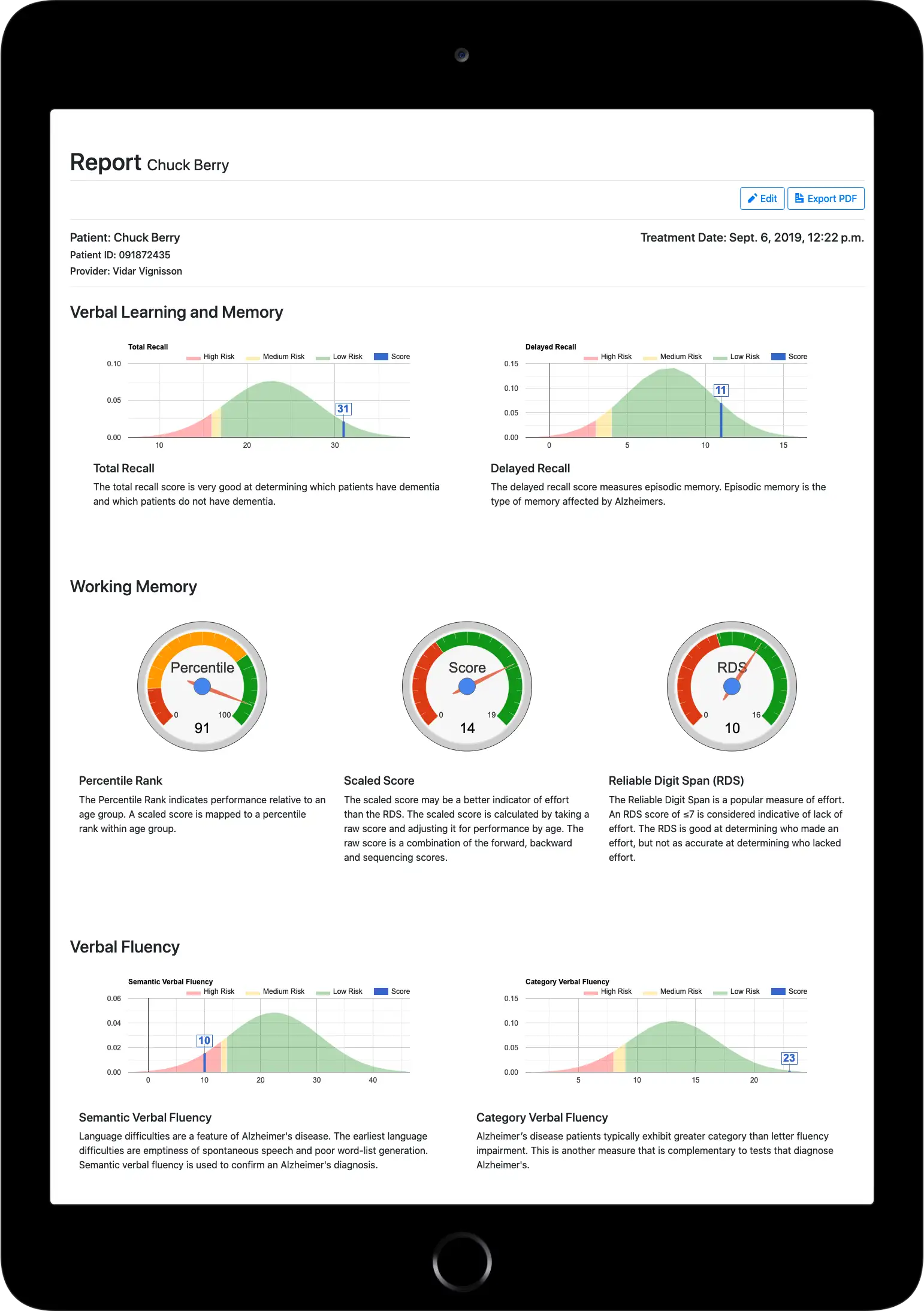
The Memory Exam is a screening test that uses spoken recall rather than recognition, scores against normative data for your age and education, and is taken at home without an appointment.
It is not a substitute for neuropsychological assessment and it does not diagnose anything. What it does that the alternatives largely do not is let you establish a baseline cheaply and repeat it later, so that a future result can be compared against your own earlier performance rather than against a population average.
Its approach has been evaluated against standard neuropsychological assessment in peer-reviewed research published in Archives of Clinical Neuropsychology, Neurology and Alzheimer's & Dementia.
Which should you take
- Something has changed suddenly, over hours or days. That is not a screening question. Seek medical help now.
- You or a family member have a specific, growing concern. Start with a screen, then take the result to a doctor.
- A doctor has a diagnostic question. Full neuropsychological assessment is the right tool.
- You want to know where you stand and track it. A baseline you can repeat is worth more than a single number.
No screening test, ours included, can tell you why your memory has changed. That question belongs to a clinician, and the point of screening is to get you to that conversation earlier and better prepared.